Landscape Lighting Installation in Portsmouth, RI: Which Layer Each Part of the Yard Needs
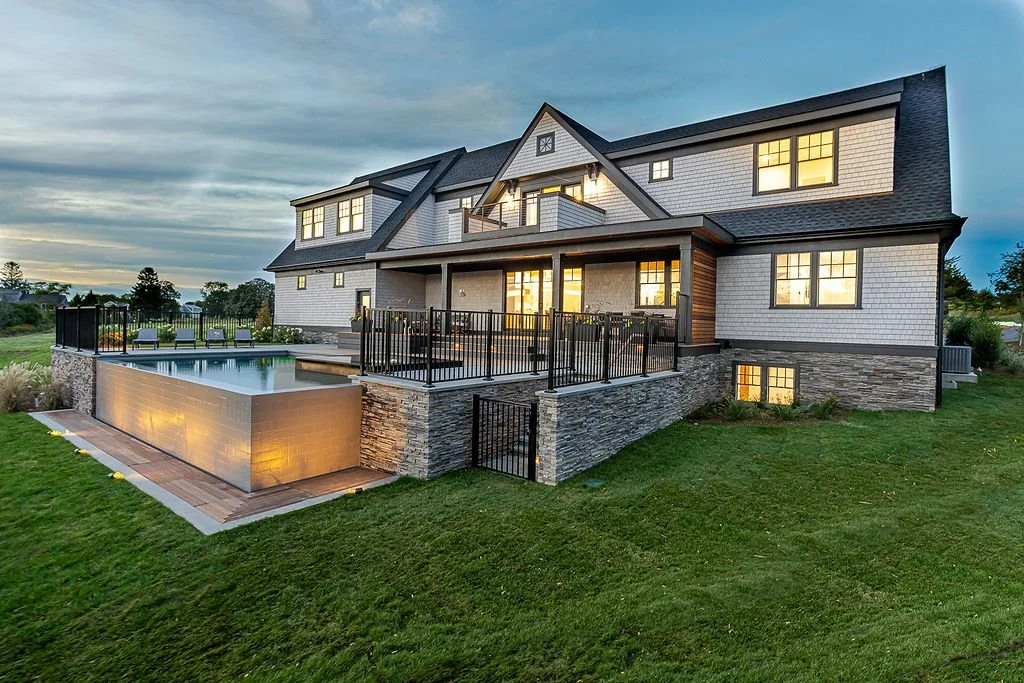
Landscape lighting installation in Portsmouth, RI, tends to get discussed as a quantity of fixtures. It works better as three separate jobs done at once.
Task light so people can move safely, accent light so the yard has depth after dark, and ambient light so a terrace feels like a room rather than a stage. Each layer answers a different question, and a yard lit with only one of them shows it.
Gairad DeCastro launched Premier Outdoor Group as a design and build company on Aquidneck Island in 2007. Working on this stretch of New England means most of the yards we light have a grade change, a water view or both, and those two features are what decide where each layer belongs.
Related: A Smarter Approach to Backyard Design in Portsmouth, RI
What Are the Three Layers a Lighting Plan Works With?
Task, accent and ambient. Task light puts usable brightness on steps, paths, cooking surfaces and pool edges. Accent light picks out the things worth looking at, such as a specimen tree or a stone wall. Ambient light fills the space between them so the eye is not jumping between bright pools and darkness.
A plan that names which layer each fixture serves is far easier to adjust later. When a homeowner says the yard feels too bright, the answer is usually the ambient layer rather than every fixture on the property.
The layers also want separate control. Running them on their own zones means the task layer can stay on for safety after the accent layer has gone off for the night.
Which Areas Need Task Light Rather Than Atmosphere?
Anywhere feet or hands are working. Step treads and grade changes, the run between the house and a terrace, a grill and prep counter, and the perimeter of water all need enough light to read a surface.
This is the layer people notice only when it is missing, usually by catching a toe on a riser that looked continuous in the dark. It is also the layer that carries the most liability on a property where guests move around after dinner.
Placement beats brightness here. Light aimed across a tread shows the edge, while light aimed at it from the front flattens the step and makes the drop harder to see.
What Does Accent Lighting Do to a Planted Bed?
It gives the yard a background. A bed lit only from above reads flat, while a fixture set low and aimed up through a tree canopy throws shadow onto the house and pushes the boundary of the yard outward.
Aim matters more than count here. Two well-placed uplights on a mature specimen do more than six fixtures spread evenly along a bed line.
The accent layer needs revisiting as plants fill in. A fixture aimed at a young tree is aimed past a mature one three seasons later, which is a half-hour adjustment rather than a new install.
How Much Ambient Light Does a Terrace Actually Want?
Less than most people install. A terrace lit to interior brightness stops feeling like an outdoor space and makes everything beyond it look black.
Lower overall levels, warm color and light bounced off a wall or a ceiling keep faces readable across a table while leaving the accent layer visible behind. Dimming control is what lets one terrace do dinner and late evening.
Color temperature holds the whole scheme together. Mixing warm and cool fixtures across one space reads as a mistake even to people who cannot name what is wrong with it.
Related: Creating Cohesive Outdoor Spaces With Professional Landscape Design in Newton and Wellesley, MA
Why Does the Lighting Layout Follow the Design?
Because light is a response to what has been built. Fixture positions depend on where the steps landed, which tree stayed, how tall the terrace wall finished and where the seating faces.
Lighting drawn alongside the layout also gets its conductor runs placed before paving goes down. Sleeves under a walk cost almost nothing at that stage and a great deal afterwards. Our team plans layered task, accent and ambient lighting as part of the outdoor living design rather than as a later addition.
Planning it early protects the fixture count as well. A layout drawn against the finished design needs fewer fixtures than one improvised around a space that is already built.
What Changes About Lighting a Sloped New England Lot?
Sight lines and glare. On a sloped property a fixture that sits comfortably below eye level from the terrace shines directly into a window on the level below, so aiming gets checked from both elevations.
Grade changes also multiply the task layer, since every set of steps needs its own treatment. A yard that steps down three times needs three solutions rather than one repeated.
Yards with a water view want the far edge left darker so the view survives. Coastal exposure matters too, since salt air is hard on fixture finishes and fittings that were specified for an inland site.
Light Your Portsmouth Backyard With Premier Outdoor Group
Walk the yard with us at dusk rather than at midday, because the hour you want it to work is the hour worth designing for.
Premier Outdoor Group designs and builds backyards, poolscapes, patios, outdoor kitchens and outdoor structures with the lighting drawn in, for homeowners across Portsmouth and New England.
In Summary
Is it better to light a yard at dusk or after full dark?
Design at dusk and check again after dark. Dusk shows how the layers balance against remaining daylight, and full dark shows glare and any spot the plan left out. Premier Outdoor Group walks both where a project allows it.
Can lighting be added to a backyard that is already finished?
It usually can, though routing conductors under finished paving is the part that costs. Beds, lawn and planting areas are straightforward; a terrace already laid is where retrofitting gets expensive.
How many fixtures does a typical backyard need?
Fewer than most quotes assume. The count follows the layers rather than the square footage, and a smaller number placed and aimed deliberately reads better than a larger number spaced evenly.
Related: Experience Luxury Living with Expert Pool Installations in the Jamestown and Tiverton, RI Areas
ABOUT THE AUTHOR
A passion for the outdoors and the experience of working with his hands at a young age fostered the realization of Gairad DeCastro’s dream to start a top-rated design/build company on Aquidneck Island in 2007. His company has since grown from humble beginnings to a sought-after local pool contractor. Now, Premier Gunite Pools is recognized as a leader in providing creative, quality, and reliable inground pools. Gairad’s philosophy and mission statement remain simple: “If it’s worth doing, it's worth doing right.” His goal is to exceed every customer’s expectations for the amount of fun and relaxation they can have with a luxurious pool in their backyard.